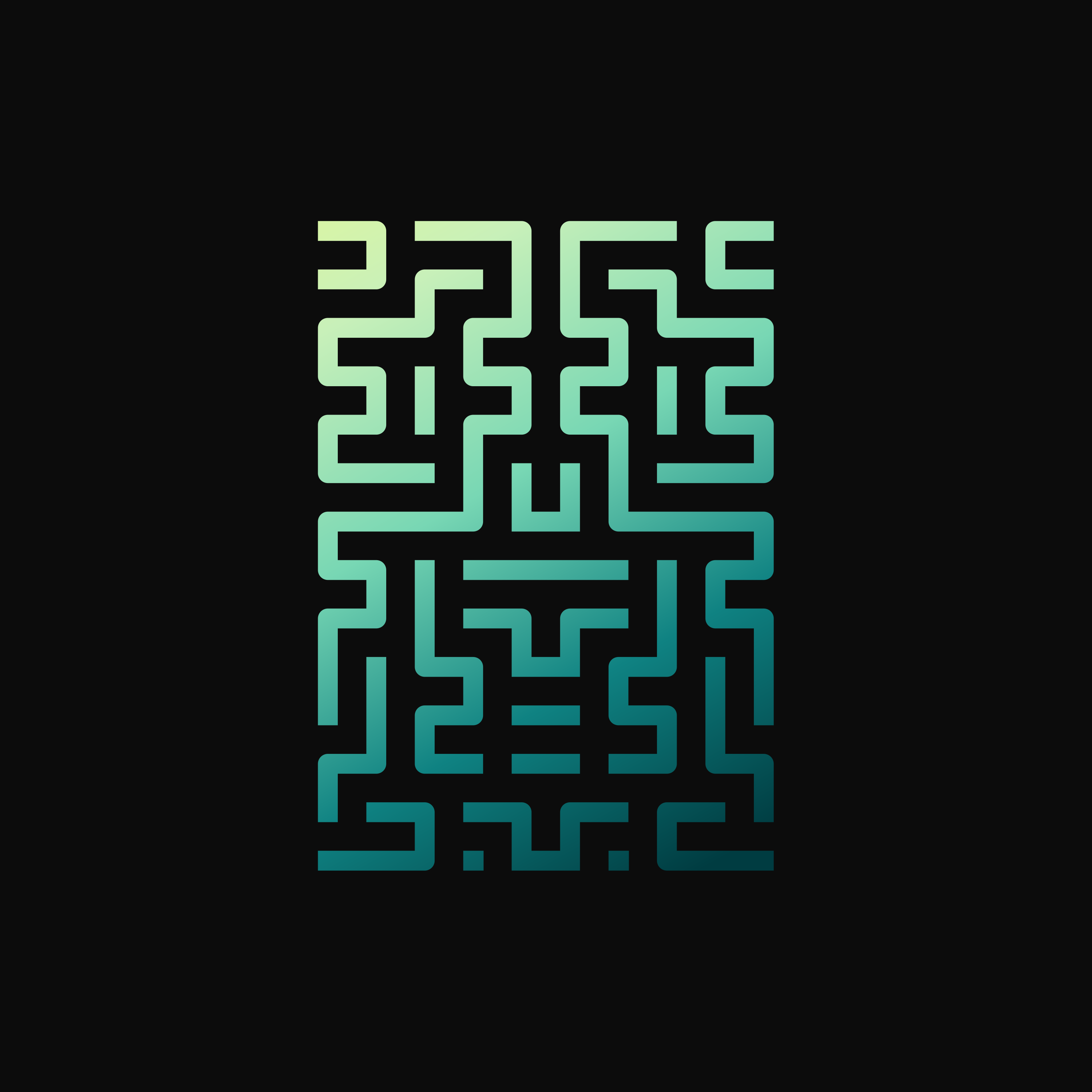

Colorvoids is a fully on-chain generative art collection — the debut solo release from a longtime collector of on-chain work, and the product of two years of quiet, patient refinement. It began from a single, stubborn starting point: warm lines compacting into a canvas, leaving room to breathe. Everything about the project still traces back to that idea.
The form
Each ColorVoid is a dense, maze-like field set in a tall, portrait layout. Thick rounded paths interlock and wind back on themselves, with the dark background threading through the gaps as negative space. Color runs through the lines, the void is the space they leave behind. That's where the name lives.
The color isn't painted on top — the gradient lives inside the stroke of every line, the material the work is made of rather than a layer over it. A single gradient flows across the whole structure, so each piece reads as one continuous mood rather than a grid of separate marks.
The restraint is deliberate. Colorvoids deliberately turns away from maximal, high-dopamine art that floods the canvas with noise, density, and as much "stuff" as possible. The modern world already offers more of everything — more feeds, more notifications, more all the time — and the collection is a step in the other direction.
So the pieces are minimal on purpose. Intentional, but not rigid. They are quiet enough to sit with: let your eyes settle and shapes and meanings surface from the simplicity. The same piece can read differently depending on the day, the mood, or how long you let yourself look. That stillness is the point. The tension that keeps it alive is that the work is minimal and controlled, yet the algorithm still has room to surprise — the constraints are set, and the work decides the rest.
Rooted in nature
Every gradient in Colorvoids is pulled from something found in nature. Mostly sunsets and sunrises — where the palette began — but the colors also come from plants, water, ice, rock, and fire. Nothing is arbitrary. Each one traces back to something real you could stand in front of.
There are 40 gradients in total, and each has an equal chance of being chosen. No single palette is rarer than another by design — the rarity lives elsewhere, in the structure of the lines themselves.
Living art: rotation and breathing
Colorvoids are not static images. They change with time — slowly, on a scale measured in years rather than seconds.
Each piece has two layered motions:
- Rotation. The gradient slowly spins around the center of the canvas. One full turn takes exactly 365 days — roughly one degree per day. Slow enough that you can almost tell the time of year by where the colors point.
- Breathing. On top of that rotation, the gradient expands and contracts along its own axis. At certain moments one end of the gradient swells to fill more of the canvas; at others it pulls back into balance. This is what creates those "sunrise" and "sunset" moments — when a single color blooms across the piece before receding.
These two rhythms run on different clocks. The rotation completes once a year, but a slower drift sits underneath it, so each anniversary lands slightly offset from the last. The breathing keeps its own separate cadence. Put together, it takes roughly 11 years for a piece to return to the exact state you're looking at right now.
Some pieces breathe gently. Others breathe dramatically, with one color sweeping across half the canvas at its peak. It's another layer of personality, and it means no two voids ever move in lockstep — even rendered at the same instant, every piece is somewhere different in its own cycle.
Structure and rarity
Minimal doesn't mean uniform. The maze itself is built from a small set of rules, and the way those rules resolve is where each piece earns its identity:
- Rounded corners and sharp corners — soft, flowing weaves versus crisp, angular labyrinths
- Thin lines and thick lines — open, airy fields versus dense, heavy ones
- Dotted path types — the weave broken into beads rather than continuous strokes
- Stacked line types
- Random pattern types
- Mirrored arrangements — symmetry folded across the frame
These combine to give the illusion of intricate, one-of-a-kind structures built from very simple rules. The thin-line, stacked, and dotted types are the rarer ones — when you see them, you're seeing something less common in the collection.
A collection that curates itself
Colorvoids has a small, intentional supply of 365 — one for every day of a year, and the same number that governs a full rotation.
A collection this small isn't meant to be fixed in stone the moment it mints. Every token carries a reroll mechanic: a holder can reroll a piece to generate a completely new design. Each token comes with two rerolls, which means it can take on up to three different Colorvoids over its life.
Two things make this interesting:
- The collection curates itself. Over time, holders decide which designs they keep and which they reroll away. There's no central hand shaping the final look — the collection becomes whatever its community collectively chooses. What it looks like in a year is genuinely unknown today.
- Rerolls are potential. A token that still has both rerolls left carries more possibility than one that's settled. That unspent potential is part of what a piece is worth — the option to change is itself valuable.
Fully on-chain
Colorvoids is 100% on-chain. The artwork is generated as SVG directly by the EVM — no servers, no external image hosting, nothing that can disappear. The rotation and breathing are computed on-chain from each token's seed and the current time, deterministically. Same inputs, same output, forever.
The contract also refuses to render a piece's future state — you can look back at any past moment, but nobody can fast-forward to spoil what a void will become. Time only moves one direction here, just like it does for the rest of us.
What it stands for
Colorvoids is a small bet on restraint — on art that asks for patience instead of grabbing for attention, on a collection shaped by the people who hold it rather than dictated from the top, and on the durable idea that something made entirely on-chain, drawn from nature, and allowed to move slowly through time is worth making.
Sit with one long enough, and it reveals itself. That's the whole invitation.